
Human Development Report Consultation
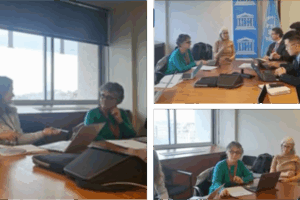
Professor Claudia Roda contributed an expert position statement to the consultation by the United Nations Development Programme (UNDP) Human Development Report Office (HDRO) with UNESCO.
The intervention, which focused on the impact of AI in higher education, is briefly summarized below.
Position statement – Human Development Report Consultation on AI in Education
In recent years, the functions and goals of higher education have shifted dramatically. Once focused on personal development and integration into society, education must now also help students make sense of, and shape, a rapidly transforming world. Climate change, the COVID-19 pandemic, wars, the erosion of democratic institutions, and the evolution of digital technologies all demand a new educational paradigm. As UNESCO’s Stefania Giannini aptly puts it:“We can no longer just ask ‘How do we prepare for an AI world?’ We must go deeper: ‘What should a world with AI look like? What roles should this powerful technology play? On whose terms? Who decides?’”[1]
Not all technologies serve educational goals equally. The value of technology in learning environments depends on careful, context-aware allocation of both technological and human resources. AI systems vary widely—from tools that preserve teacher agency and privacy, to those that centralize data and decision-making in opaque algorithms. This raises crucial questions about transparency, explainability, and human oversight. For educators to meaningfully use digital tools, the tools must directly address educational needs and be flexible enough so that educators can adapt them to their students’ needs. Education cannot be a playground for “experimenting” with AI using children/students as guinea pigs. We must ask, then: When is AI useful in education? What problems is it solving? Where might our resources be better invested—in software, or in people?
For example, AI-driven tutoring or assessment platforms may be beneficial in contexts with high student-teacher ratios, but are they more effective or equitable than hiring and training more educators? Across higher education administration (admissions, advising, registration, and career support) AI may ease workloads, but it also raises concerns about fairness, privacy, and accountability.
Currently, access to information and student data is centralized in privately owned platforms, threatening academic freedom, local adaptation, and democratic accountability, while also making it difficult to counter misinformation and manipulation. How do we ensure that control is returned to public institutions, educators, and communities?
These questions ask us to weigh efficiency against equity, and automation against empowerment.
The path forward requires critical reflection, inclusive dialogue, and sustained investment in, and consultation with, human educators.

[1] Giannini, Stefania. 2023. “Generative AI and the Future of Education.” UNESCO Digital Library. https://unesdoc.unesco.org/ark:/48223/pf0000385877